Residential Building with Hall
(Palas)
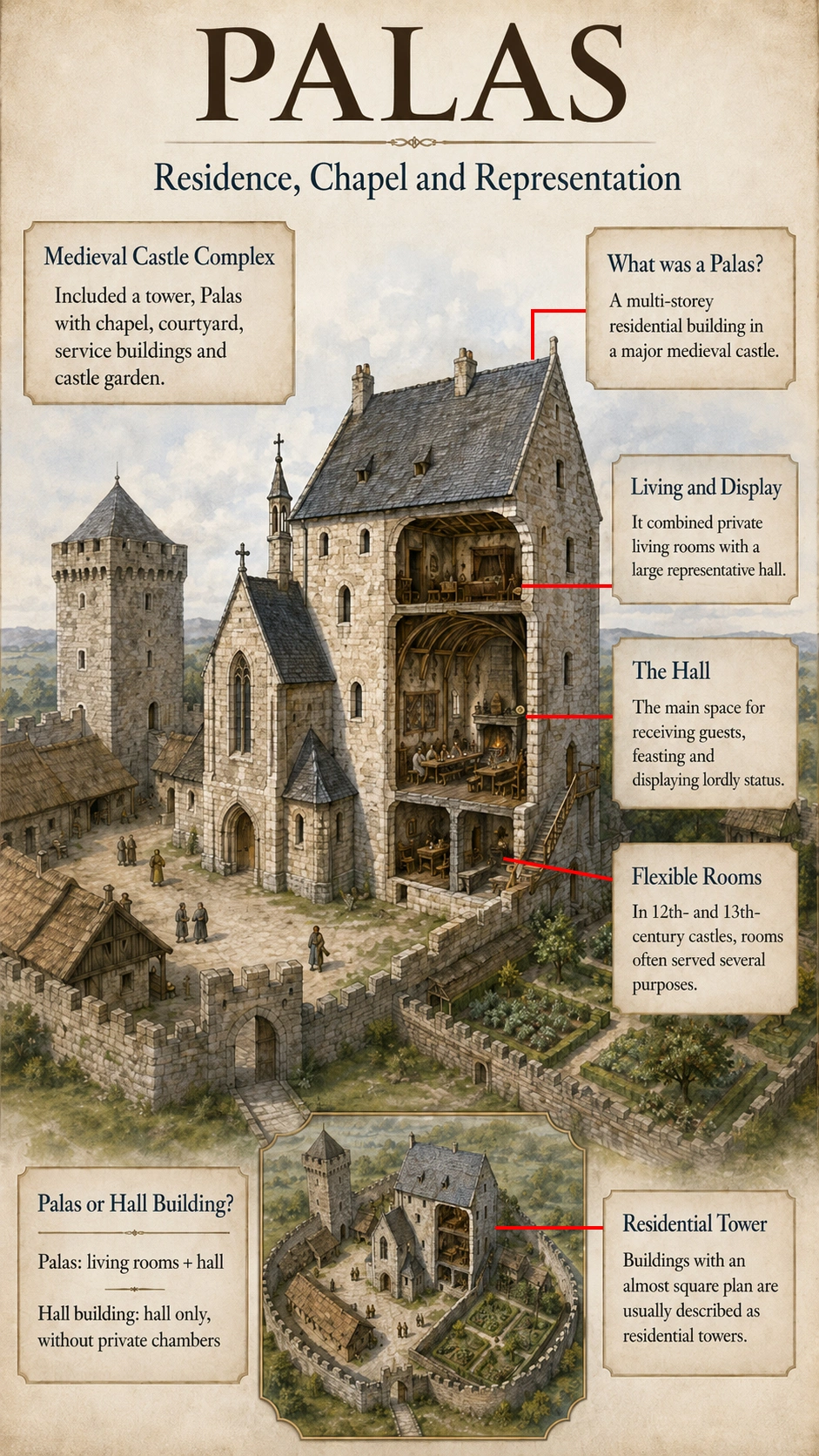
The Siegfriedstein castle complex is being constructed on the castle hill and the terraces below. It comprises a tower, a residential building with chapel (the palas), a castle courtyard, service buildings and a castle garden. The inner ward includes the residential tower with ring wall (Construction Phase I).
Terminology
Residential and Representational Buildings
Within this context, several terms are used to describe buildings intended for residence and representation within the core castle. The most common are residential building (Wohnbau), residential tower (Wohnturm), palas and hall building (Saalbau), and occasionally women’s quarters (Kemenate). However, the definitions and usage of these terms often overlap.
Spatial Organisation
in High Medieval Castles
In functional terms, residential buildings in High Medieval castles presumably followed a roughly defined spatial layout. However, many rooms were used for multiple purposes, making their functions difficult to determine today. Such flexible spatial organisation is especially characteristic of castles from the 12th and 13th centuries.
Hall
(Saal)
Within this spatial framework, the hall (Saal) was a principal space for representation and, from the High Middle Ages onwards, appeared in various forms in most castles. In the Burgbau complex, it is built into the Gothic residential building.
Palas
The palas is a key element of any castle complex. The term is widely used and often applied broadly. It refers to multi-storey residential buildings in major feudal castles of the 11th to early 13th centuries. These buildings included living quarters as well as a large hall. A defining feature of the palas is its representational combination of residential and hall functions.
Hall Building
(Saalbau)
By contrast, a hall building (Saalbau) is understood to be a structure consisting solely of one or more halls, which may be accompanied by associated side rooms, but not by living spaces such as a parlour or bedchamber.
Solid House
(Festes Haus)
In earlier phases of development, the term “solid house” (festes Haus) was often used in the 11th century to describe a single stone residential building within a largely timber-built castle complex. However, early examples of such buildings have not survived. If they exist at all, they can only be identified through archaeological evidence.
Residential Towers
From a structural perspective, buildings with a roughly square plan are more likely to be residential towers.