Basket weaving is one of the oldest craft activities. In the arid regions of the Near East, baskets around 12,000 years old have been found.
Basket making may even be older than pottery, as the first ceramic vessels originated from baskets sealed with clay, which were accidentally fired and thus became stable.
When it became a distinct profession cannot be determined with certainty. From the early Middle Ages, we lack records and information about basket weaving.
In the various craft guilds founded at the beginning of the 13th century, basket makers are not mentioned – though a number of craftsmen who used baskets are.
It is likely that some craftsmen wove baskets for their own use. The fishermen wove fish traps. The bird catchers wove cages. The farmers wove fences, transport baskets, huts and, possibly as a sideline, baskets for bakers and brewers.
The first guilds were established in Germany.
In 1590, the first basket makers’ guild was recorded in Munich.
Berlin received its own guild in 1735.
Basket Weaving Tools
Basket weaving is the craft that requires the fewest specialised tools. Basket makers managed with very little equipment; it essentially consisted of a shaving horse, a knife, a scraping blade, a splitting blade and a mallet.
Materials and Uses in the Middle Ages
In the Middle Ages, rods from hazel, willow, alder and hornbeam were woven into fences and hurdles, doors and gates, infill panels in half-timbered construction, and wall linings in pits. A wide variety of transport and storage baskets were made from willow, poplar or hazel rods – as well as fish traps and cradles or prams. Mats were woven from bast, rushes and reeds.
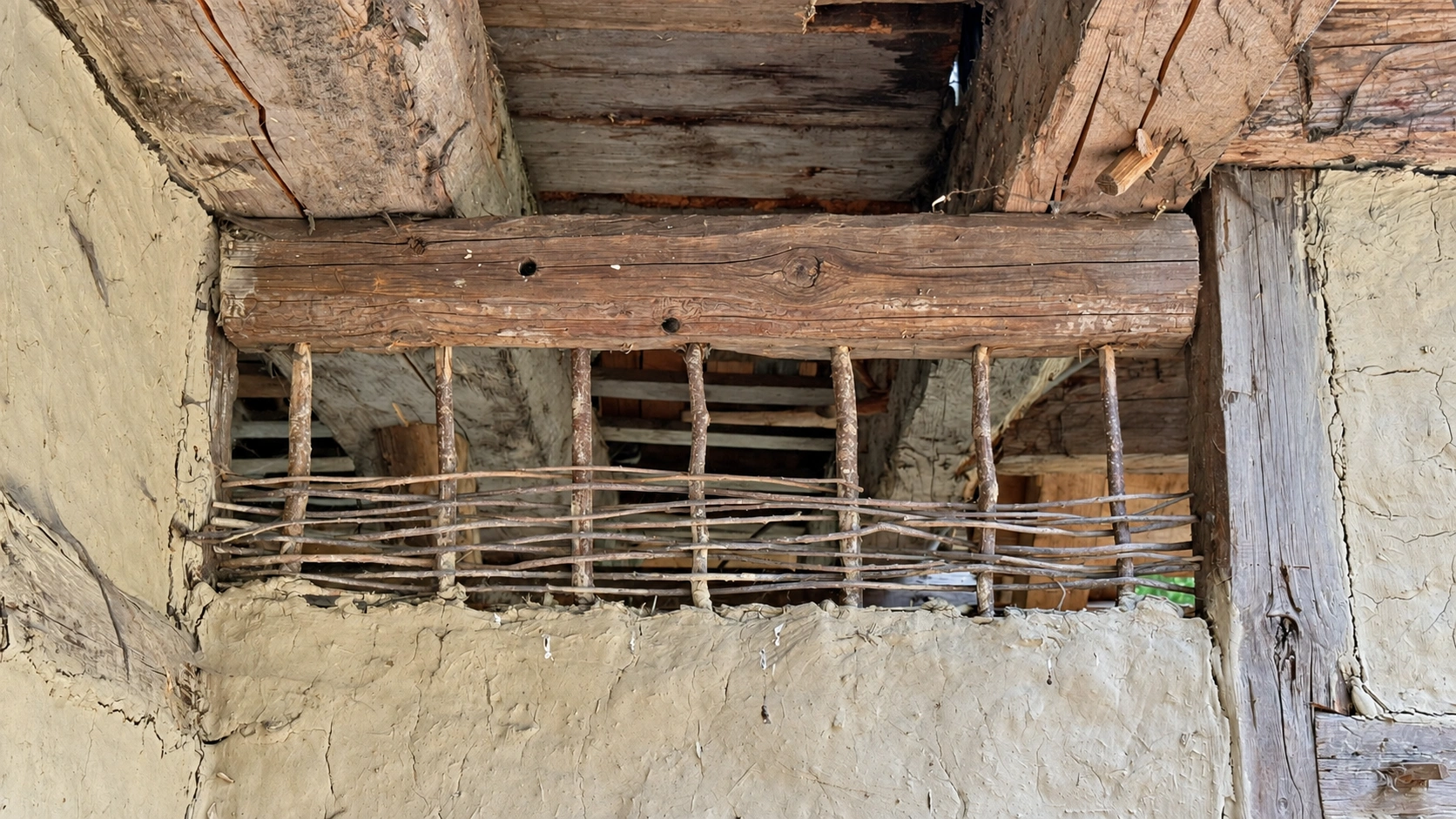
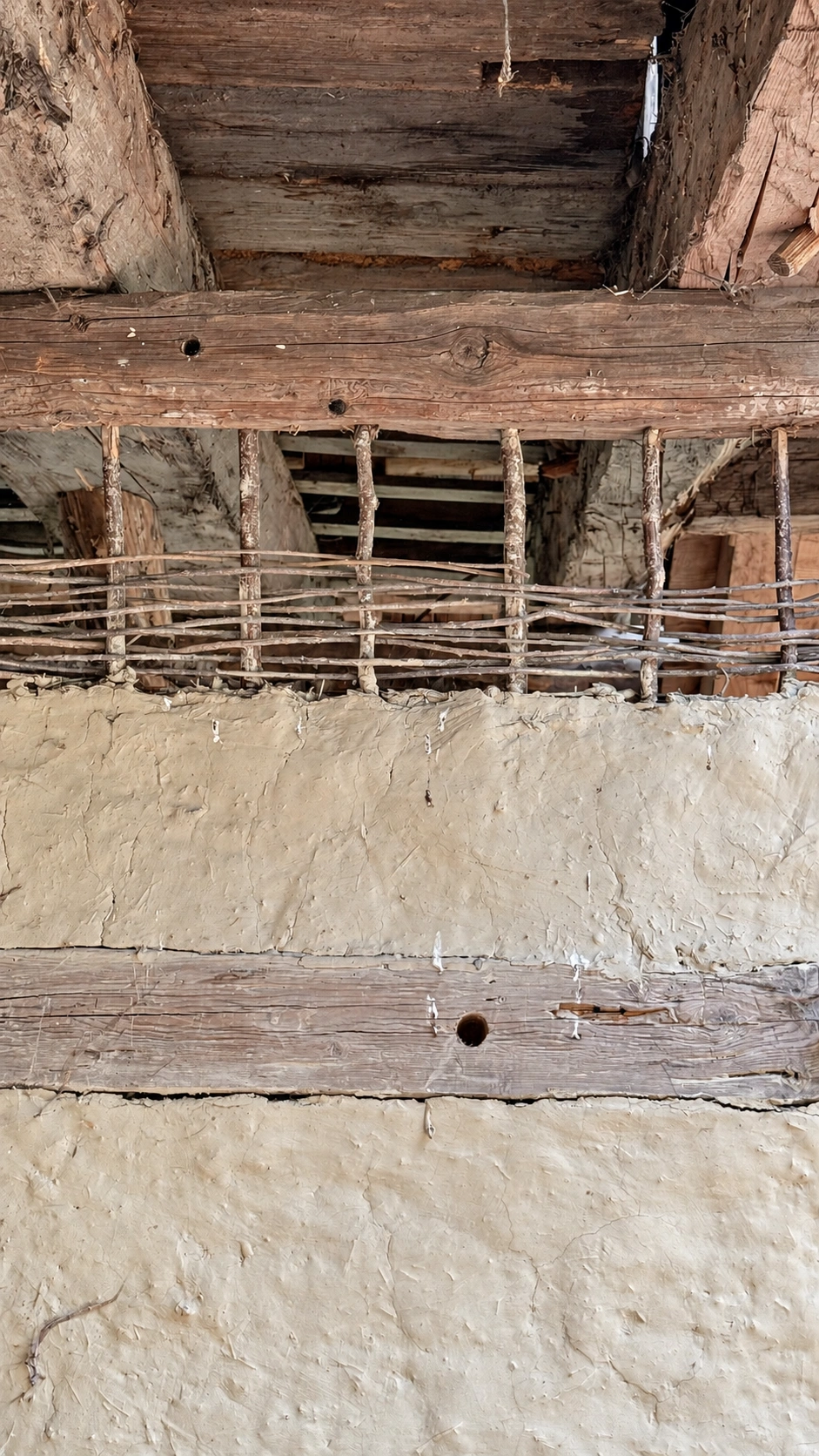
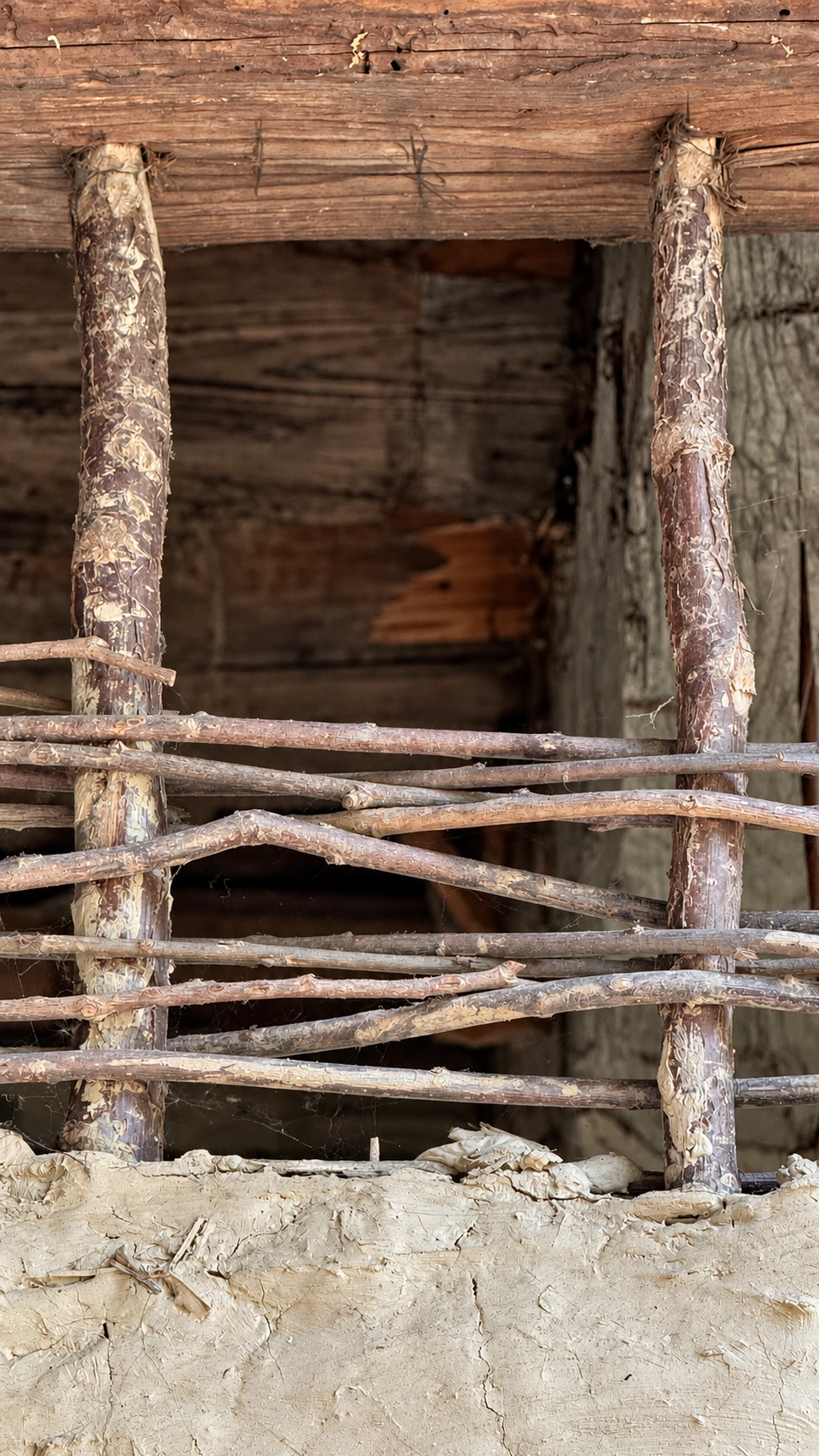
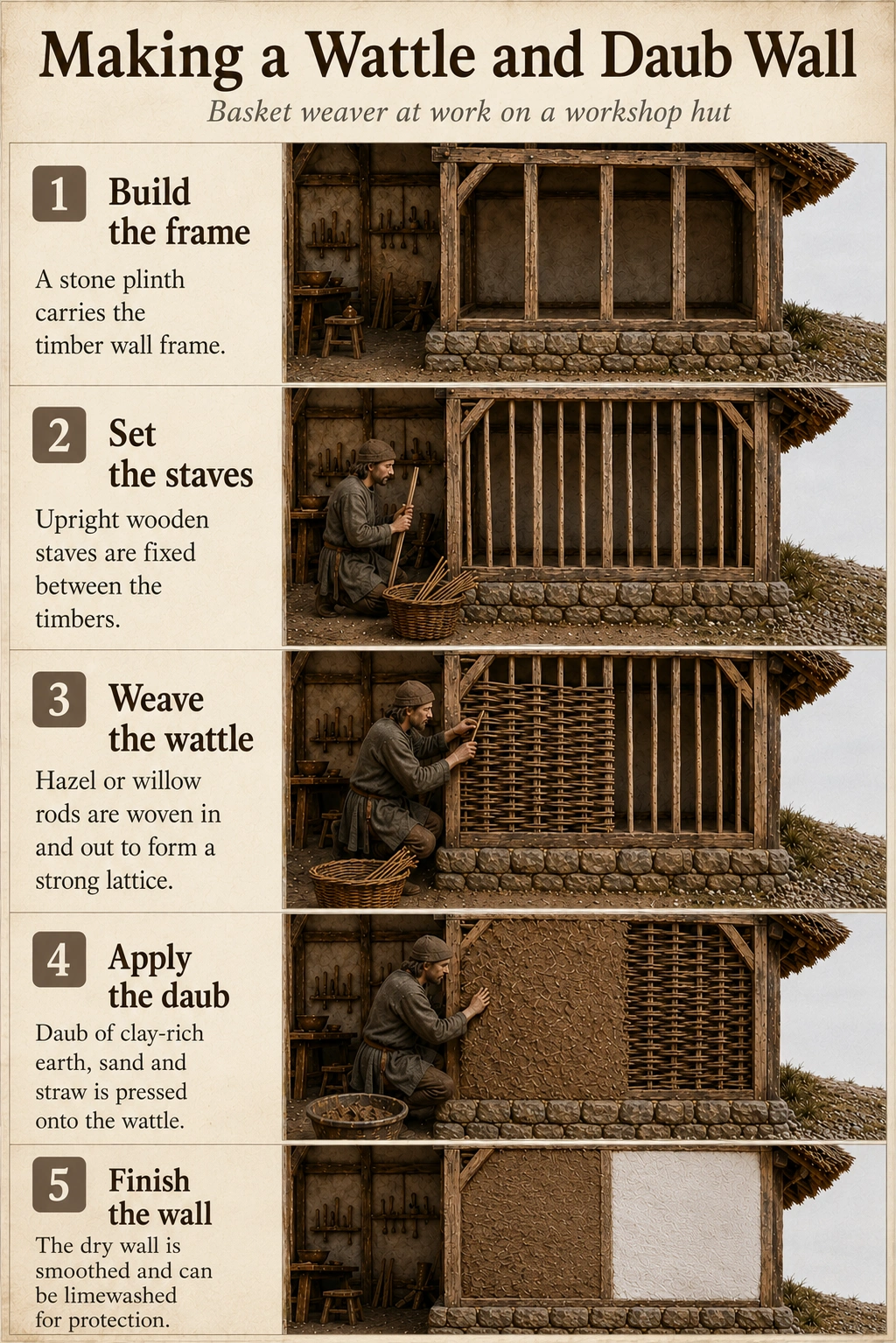
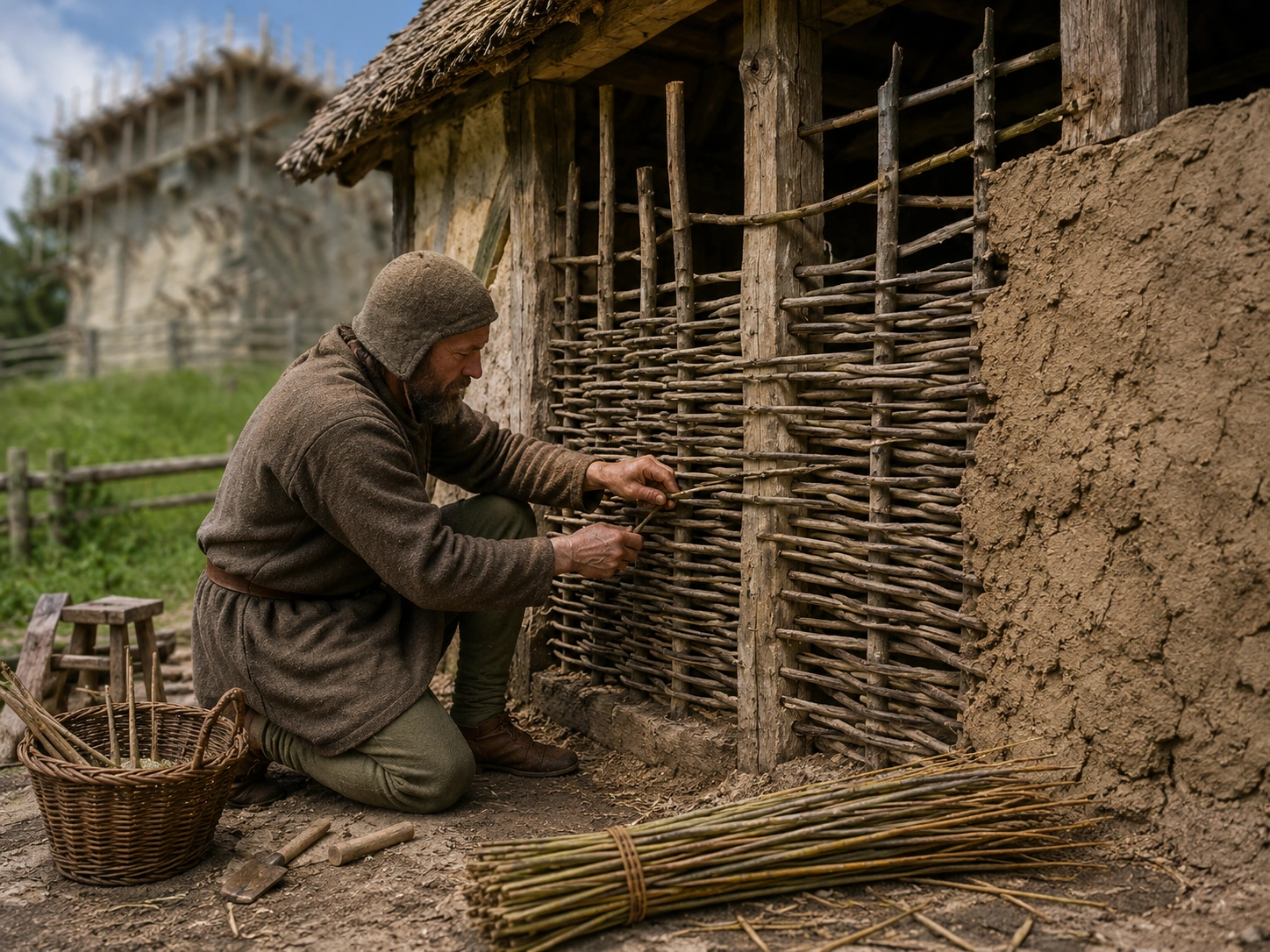
At the Burgbau construction site, willow is woven into infill for huts, as can be seen on a deliberately exposed section of the wall at the carpentry workshop.
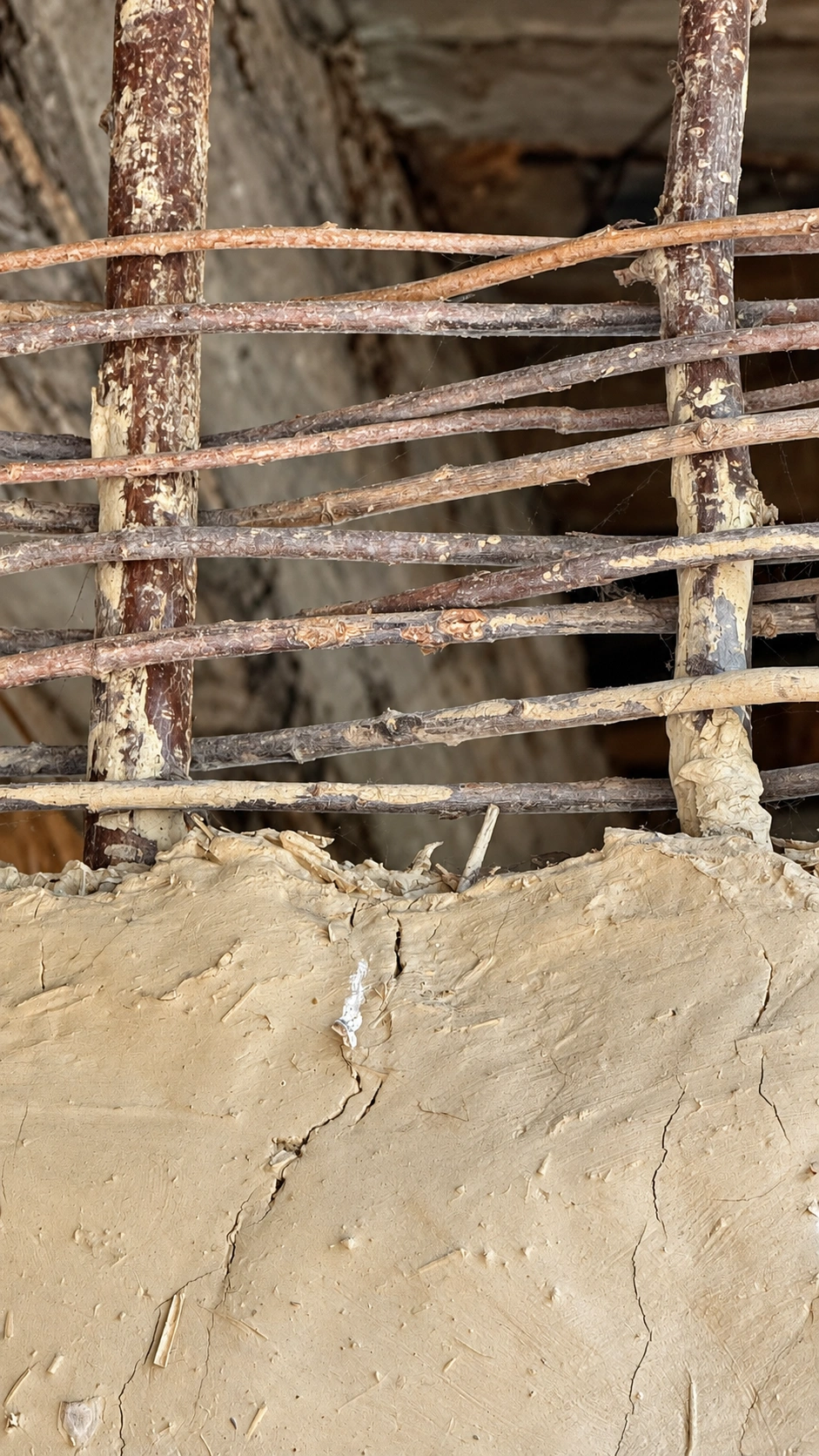
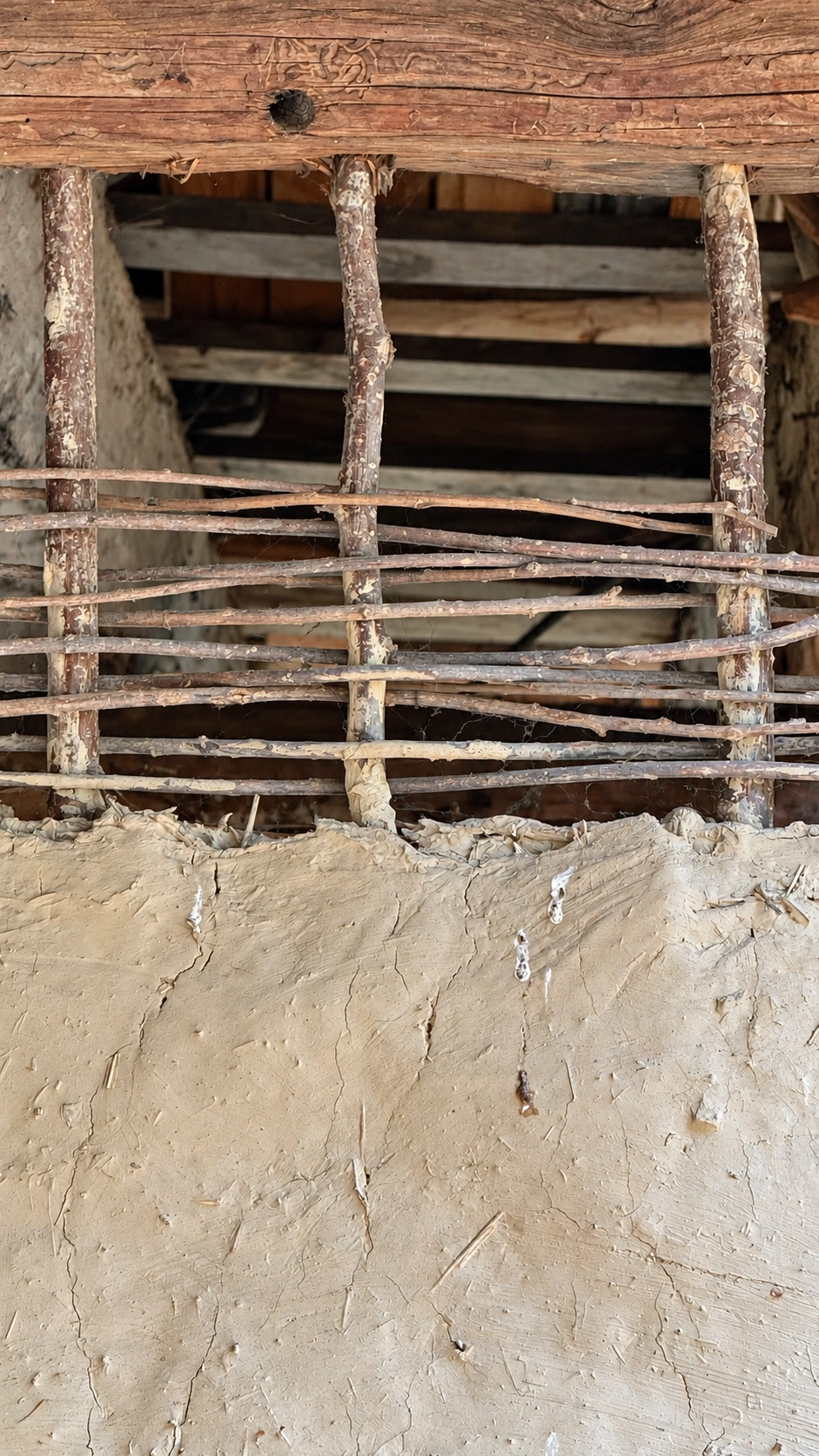
Vertical stakes support woven rods within the timber frame. The exposed section reveals the wattle beneath the daub.
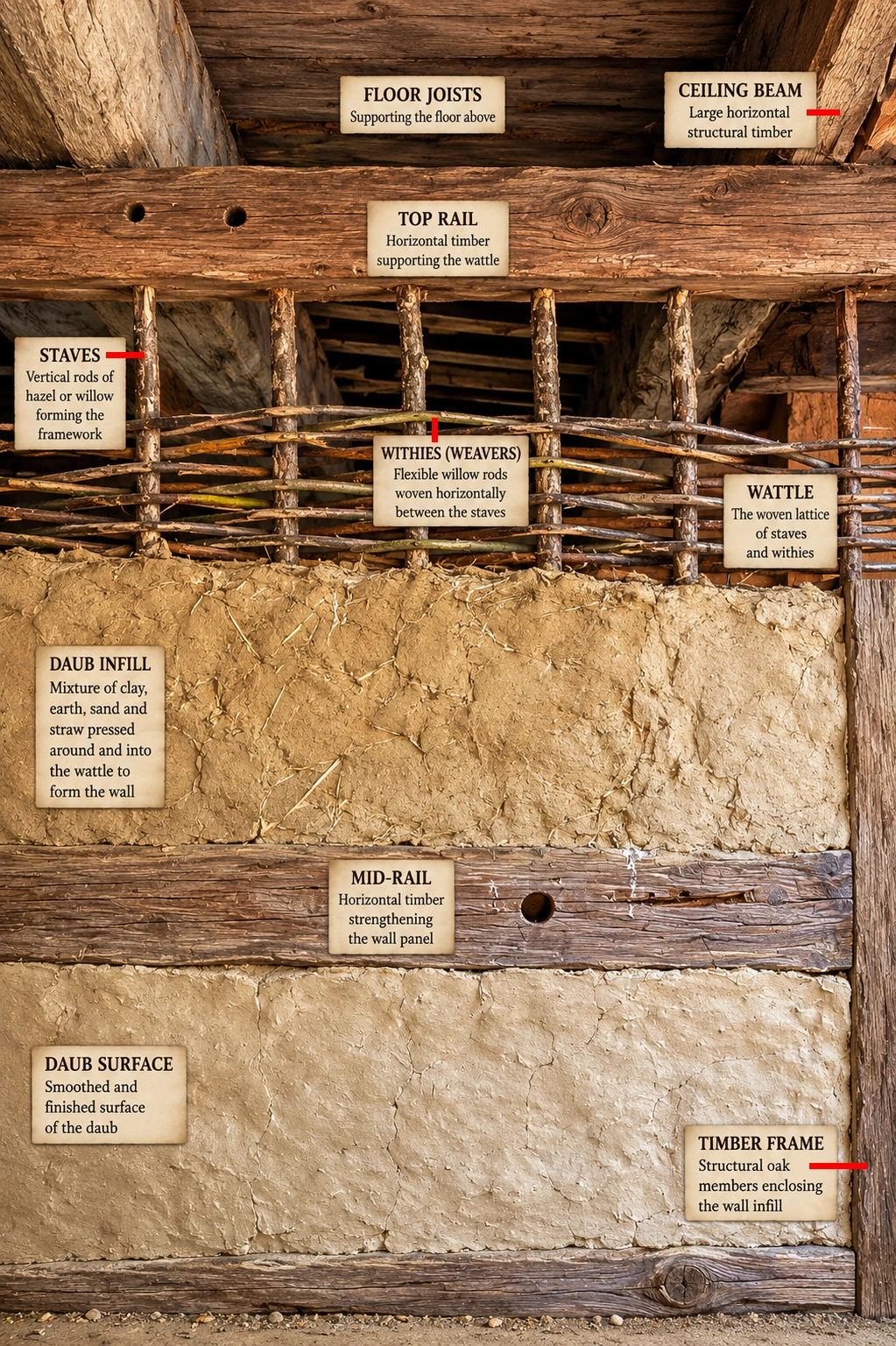
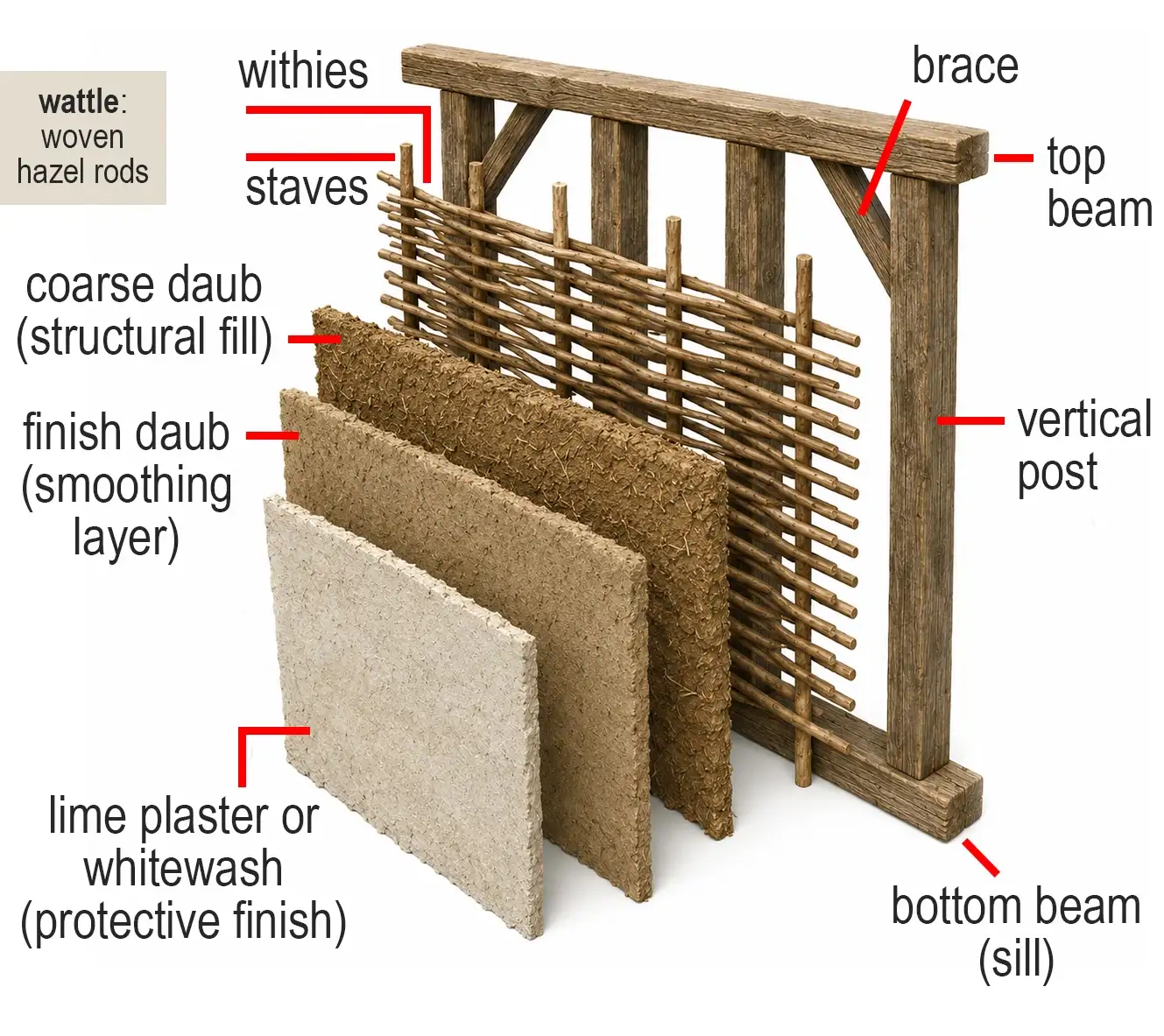
The wall shows a horizontal beam, exposed wattle framework, daubed wall and lower timber member.
An exposed wall section reveals how woven wattle formed the base for medieval daub walls.
Vertical staves are fixed to the beam above. Horizontal woven rods complete the framework.
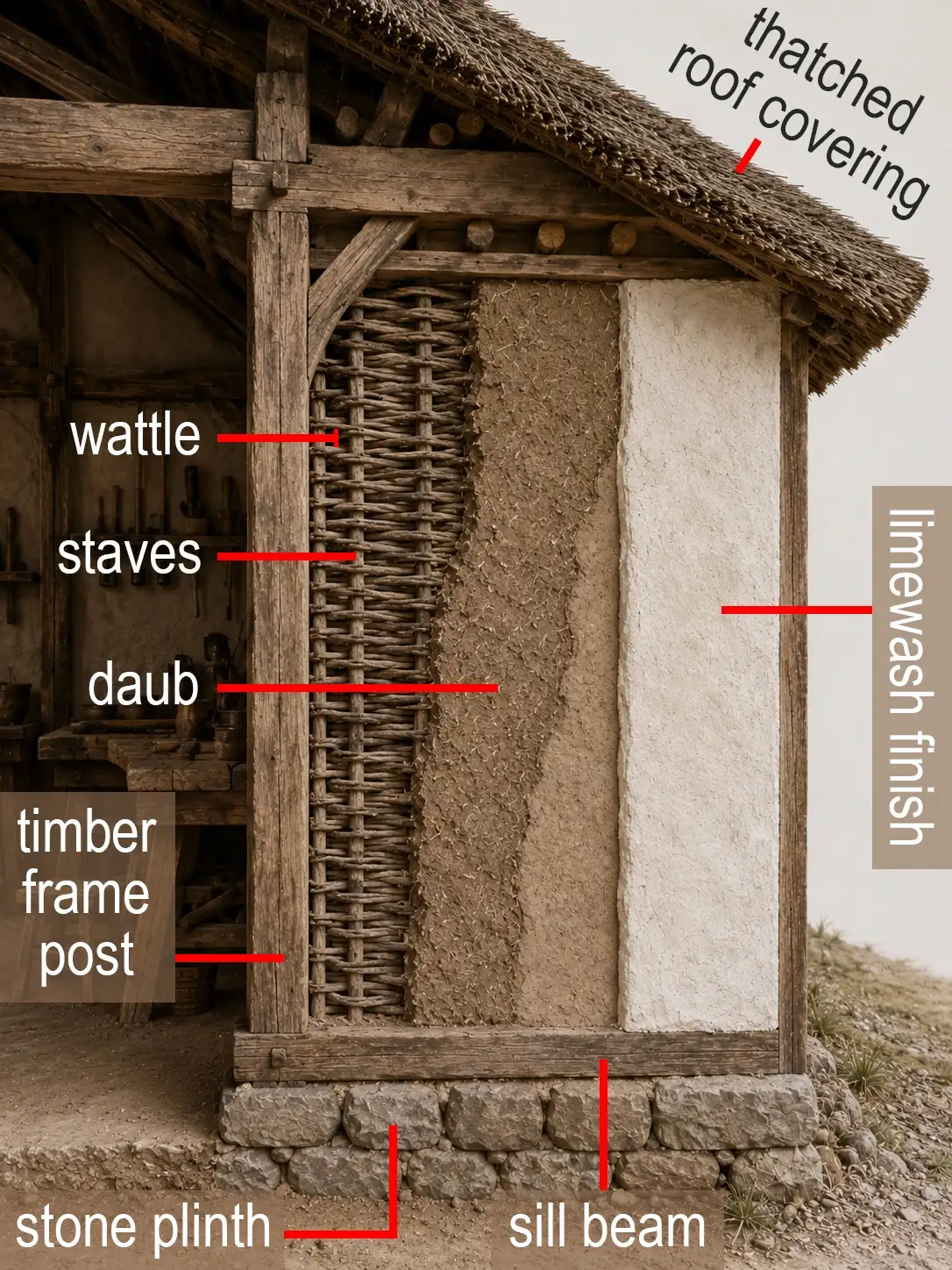
Thatched Roof Covering Provided a weatherproof covering and shed rainwater away from the wall. The projecting eaves helped protect the wall from erosion.
Wattle (Woven Withies) Flexible rods, typically of willow or hazel, woven between the staves to form a lattice that supported the daub.
Staves Vertical wooden rods fixed into the timber frame. They formed the primary framework of the wattle and supported the woven withies.
Daub A mixture of clay-rich earth, sand, straw and other fibres applied to the wattle. It enclosed the wall panel, reduced draughts and provided insulation.
Timber Frame Post Principal vertical structural member of the timber frame. It carried loads from the roof and transferred them to the sill beam and foundation.
Stone Plinth Raised the timber frame above ground level, protecting it from moisture and reducing the risk of decay.
Sill Beam (Sole Plate) Horizontal timber at the base of the wall frame. It supported the wall posts, secured the staves and transferred loads to the stone plinth.
Limewash Finish Breathable protective coating applied over the daub. It improved weather resistance while allowing moisture to evaporate from the wall.
Thatched Roof Covering Provided a weatherproof covering and shed rainwater away from the wall. The projecting eaves helped protect the wall from erosion.
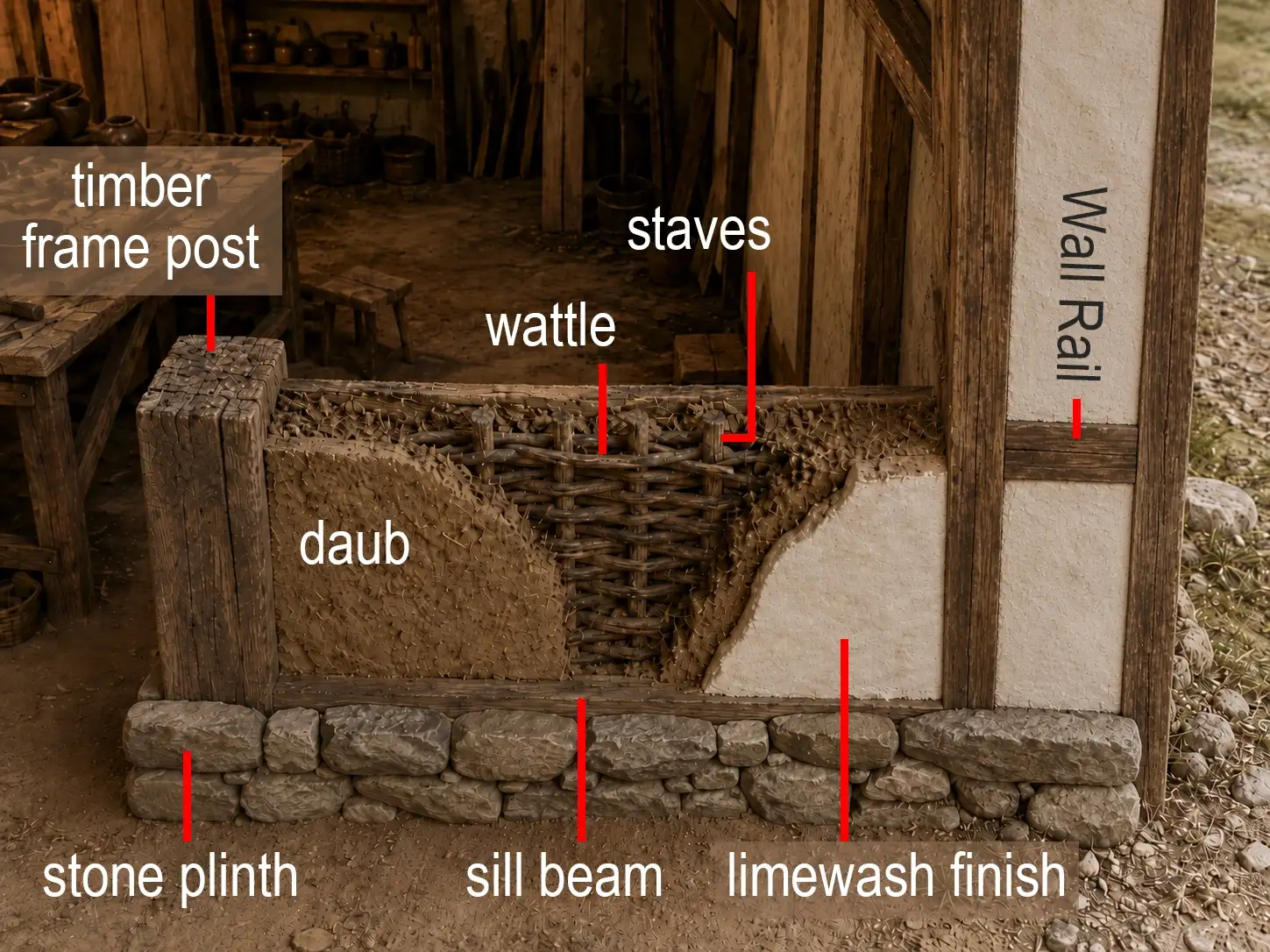
Wattle (Woven Withies) Flexible rods, typically of willow or hazel, woven between the staves to form a lattice that supported the daub.
Staves Vertical wooden rods fixed into the timber frame. They formed the primary framework of the wattle and supported the woven withies.
Daub A mixture of clay-rich earth, sand, straw and other fibres applied to the wattle. It enclosed the wall panel, reduced draughts and provided insulation.
Timber Frame Post Principal vertical structural member of the timber frame. It carried loads from the roof and transferred them to the sill beam and foundation.
Stone Plinth Raised the timber frame above ground level, protecting it from moisture and reducing the risk of decay.
Sill Beam (Sole Plate) Horizontal timber at the base of the wall frame. It supported the wall posts, secured the staves and transferred loads to the stone plinth.
Limewash Finish Breathable protective coating applied over the daub. It improved weather resistance while allowing moisture to evaporate from the wall.
Wall Rail Horizontal timber member spanning between the wall posts. It strengthened the frame, divided the wall into smaller panels and provided support for the wattle-and-daub infill.
Medieval basket weaver weaving wattle into a "wattle and daub" wall of a workshop hut