Three Types of Medieval Axes
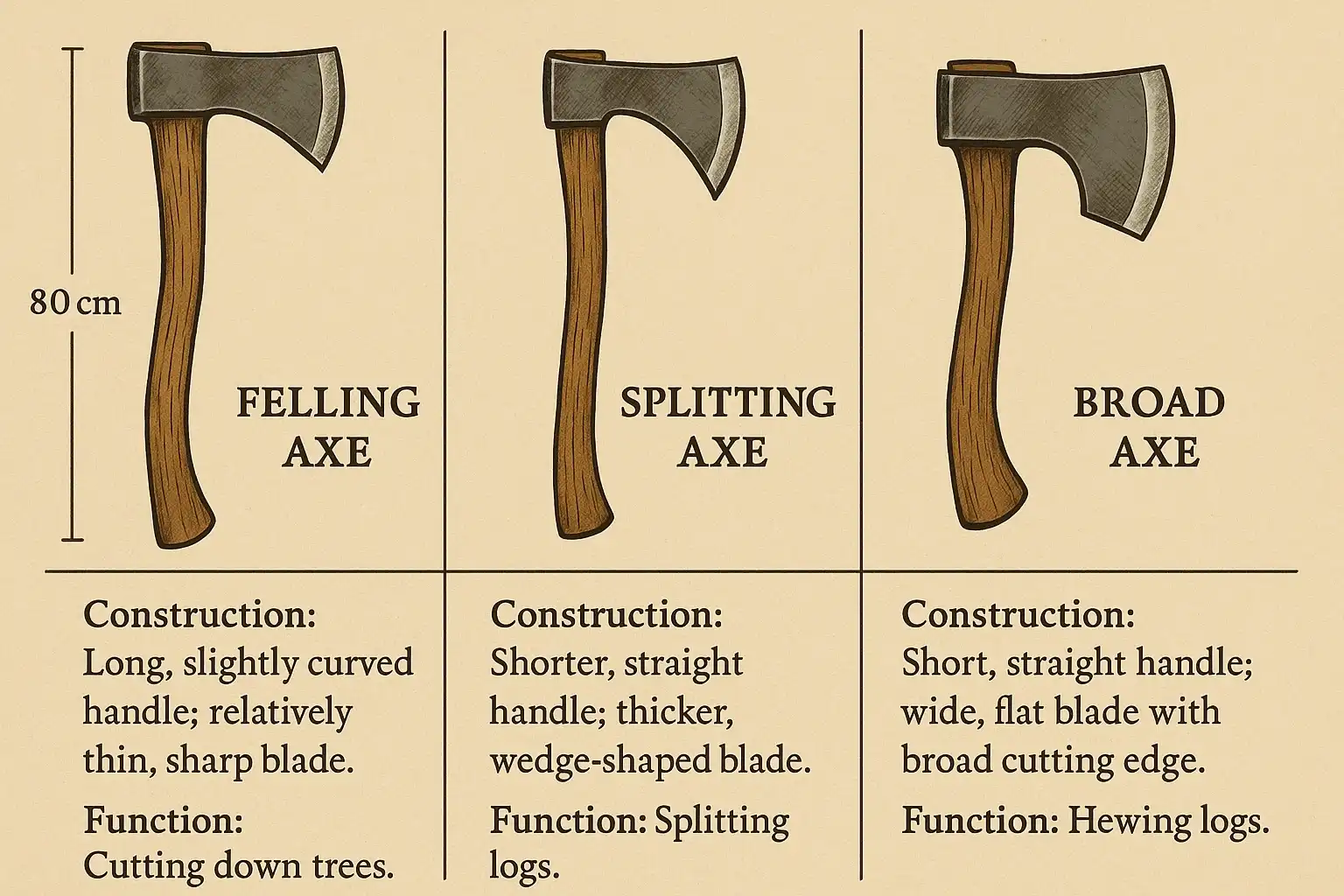
Felling Axe | Splitting Axe | Broad Axe
The three types of axes used for the construction of medieval castles are compared below:
Felling Axe
Construction:
- Long wooden handle (60 to 90 cm) for leverage and reach.
- Thin, sharp head (1.5 to 2.5 kg) with a narrow bit designed to cut across wood fibres.
- Double-bevelled bit for cutting from both directions.
Function:
- Used for felling trees, cutting across the grain.
- Thin blade made deep, clean cuts, ideal for forestry work.
Splitting Axe
Construction:
- Heavier, wedge-shaped head.
- Bit flared to push wood apart.
- Shorter haft for control.
- Some made entirely of iron, though wooden hafts were common.
Function:
- For splitting logs along the grain.
- Wedge shape forced fibres apart, relying on weight and shape rather than slicing.
Broad Axe
Construction:
- Wide, heavy head with flat bit, often offset or single-bevelled.
- Handles could be straight, curved, or angled for flush cuts.
- Head could weigh up to 3 kg, bit up to 30 cm wide.
Function:
- Used for hewing: shaping logs into square beams or planks.
- Flat side allowed close work; bevelled edge ensured smooth cuts.
- Important in timber framing and building construction.
What is bevelling?
Bevelling (or beveling in American English) refers to the process of creating an angled surface or edge on a material, rather than a sharp 90-degree edge.
In the context of axes or tools, bevelling means shaping the cutting edge so that it slopes or tapers, usually to form a sharp blade. This angled edge helps the blade cut smoothly and efficiently through wood or other materials. For example:
- A single-bevelled axe has the bevel (the sloped cutting edge) on one side only, creating an angled blade that can make precise cuts, often used for shaping wood.
- A double-bevelled axe has bevels on both sides, producing a symmetrical edge better suited for chopping.
So, bevelling is essentially the process or feature of having a slanted edge instead of a flat or squared edge.